
Programmatic Advertising in Uruguay: What Is It and What Is It For?
In the contemporary advertising ecosystem, the way brands purchase and manage their advertising space has changed radically. Uruguay is no exception to this global transformation. Gone are the days when digital and print media acquisition depended exclusively on manual negotiations, phone calls, and static contracts that consumed weeks of planning. Today, programmatic advertising has positioned itself as the most advanced standard to reach the right audiences, at the opportune moment, and with the precise message.
Despite its notable global and regional adoption, within the Uruguayan market there are still questions regarding its reach, its differences compared to other advertising alternatives, and the concrete way local companies can make the most of it. Integrating this model into a digital marketing strategy allows Uruguayan companies to optimize budgets with a level of granularity previously unthinkable.
In this comprehensive article, we will analyze in depth what programmatic advertising is, how its technology works, its current state in Uruguay, and what exactly it is used for, covering everything from mobile device screens to digital out-of-home media.
Table of Contents
- What is programmatic advertising and how exactly does it work?
- The landscape of programmatic advertising in Uruguay
- The evolution toward pDOOH: Programmatic out-of-home advertising in Uruguay
- Differences between programmatic advertising and other digital channels
- What is programmatic advertising used for and when should you implement it?
- Steps to execute a successful programmatic advertising campaign in Uruguay
- Summary of advantages of programmatic advertising
- The future of programmatic buying in the Uruguayan ecosystem
What is programmatic advertising and how exactly does it work?
Programmatic advertising is the automated buying and selling of digital advertising space in real time, using advanced algorithms and tech platforms. Instead of buying a specific space on a specific website or news portal (for example, acquiring a fixed banner for a week on a Uruguayan newspaper), the buyer purchases the opportunity to serve an ad to a specific person who meets certain demographic, behavioral, or purchase intent criteria, regardless of the site they are visiting at that moment.
This ecosystem operates in a fraction of a second—approximately 100 milliseconds—from the time a user enters a website or opens a mobile app until the content finishes loading. The entire process is orchestrated through a series of interconnected technologies:
- DSP (Demand-Side Platform): The platform used by advertisers and agencies to set up campaigns, define audiences, and automatically bid on available ad spaces.
- SSP (Supply-Side Platform): The tool used by media outlets and websites (publishers) to offer and monetize their ad inventory in an automated way.
- Ad Exchange: The centralized virtual marketplace where SSP supply meets DSP demand through real-time auctions (RTB - Real-Time Bidding).
- DMP (Data Management Platform): The platform that collects, centralizes, and analyzes audience data to feed buying decisions with higher precision.
In simple terms: technology analyzes who the user visiting a site is, evaluates whether they match the profile desired by advertisers, and runs an ultra-fast auction. The winner displays their ad seamlessly to the end user.
The landscape of programmatic advertising in Uruguay
Uruguay presents sociodemographic and connectivity characteristics that make it an ideal testing ground for the maturation of programmatic buying. With internet penetration exceeding 90% of the population and a highly developed telecommunications infrastructure (with widespread fiber optic coverage and high-speed networks), the Uruguayan consumer is intensely digital.
Historically, the Uruguayan advertising market was characterized as a concentrated environment, where direct negotiations between media agencies and major media groups dominated the advertising pie. However, in recent years we have witnessed an accelerated transition toward the programmatic digital environment due to several decisive factors:
1. Connectivity and consumer digitization
Uruguayans consume content across multiple devices simultaneously. From smartphones and desktops to Smart TVs and gaming consoles, their digital presence is continuous. This multi-channel reality requires brands to use solutions like programmatic advertising to avoid oversaturating users and to track cross-device conversion paths.
2. Availability of local and international inventory
Currently, major news portals, local media outlets, entertainment platforms, and blog networks in Uruguay have integrated SSPs to offer their programmatic inventory. This allows local brands to advertise on both high-traffic Uruguayan sites and international media read from Uruguay (e.g., global news outlets, entertainment, or specialized portals).
3. Greater professionalization and data adoption
Agencies and marketing departments in Uruguay have advanced substantially in adopting data management tools. The ability to combine First-Party Data with Third-Party Data to create specific segments (such as "people in Montevideo looking for auto financing" or "users in Maldonado interested in real estate") has raised advertising efficiency standards in the country.
The evolution toward pDOOH: Programmatic out-of-home advertising in Uruguay
One of the most revolutionary and fastest-growing advances in the national context is the fusion of programmatic advertising with digital out-of-home media, a phenomenon known as pDOOH (Programmatic Digital Out of Home).
Traditionally, out-of-home advertising was managed through static circuits where a brand contracted billboards for weeks or months, lacking immediate flexibility or the ability to segment by hours or weather conditions. Today, digital transformation has completely renewed this classic channel.
In major Uruguayan cities, particularly in Montevideo and the metropolitan area, the presence of street advertising has migrated from static displays or banners to high-definition LED screens connected to programmatic platforms. This advance covers key points across the city:
- High-traffic avenues and intersections: Screens installed along major arteries such as Rambla, Av. 18 de Julio, Av. Italia, and Bulevar Artigas.
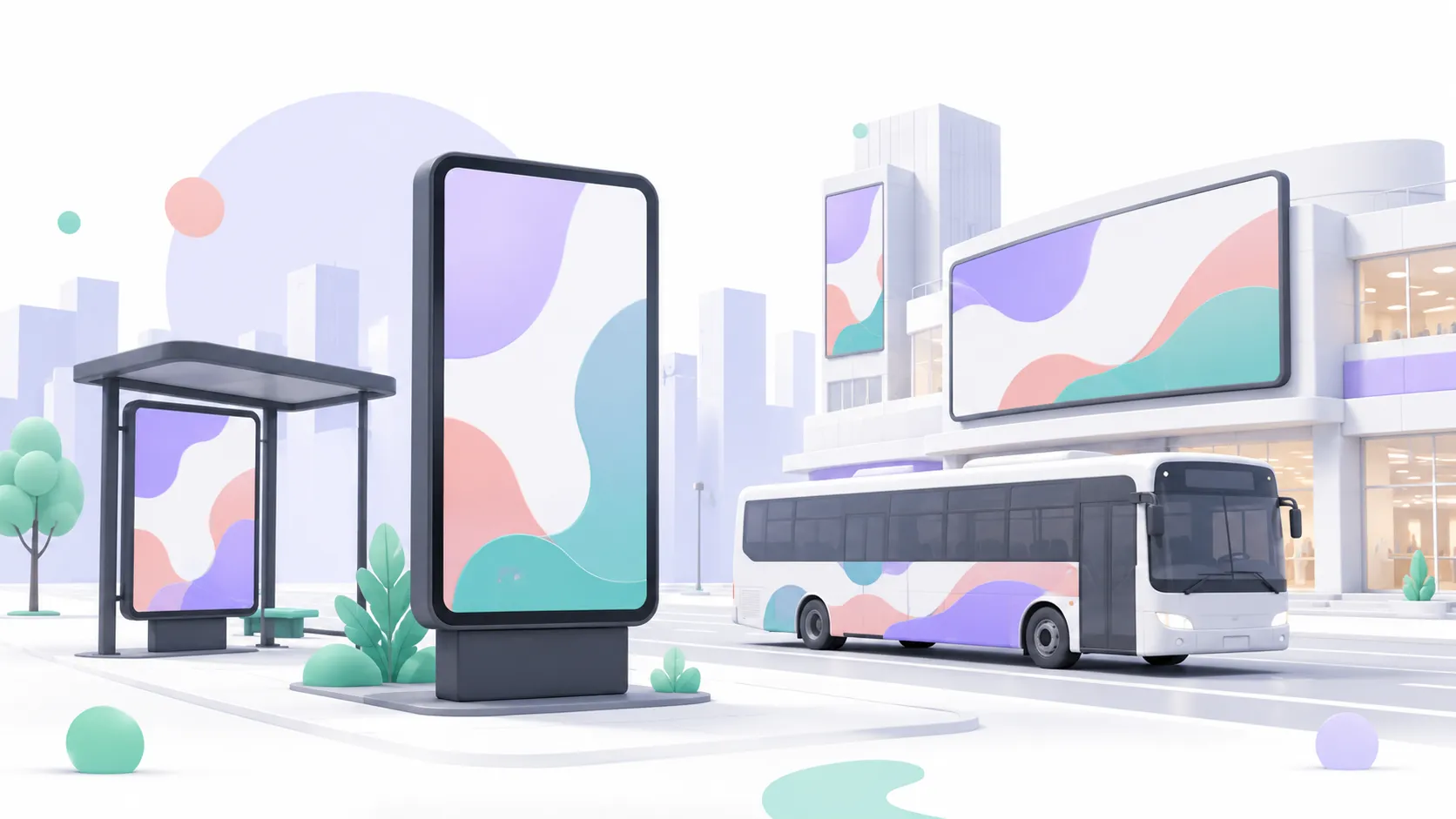
- Bus stop advertising and pedestrian shelters: Urban furniture equipped with dynamic digital screens impacting thousands of commuters daily.
- Shopping centers and high-footfall spots: Digital formats in malls like Montevideo Shopping, Punta Carretas, Tres Cruces, and Nuevocentro, reaching users close to the moment of purchase.
- Mass transit units: Formats for bus advertising with interior screens that entertain and inform passengers throughout their urban and interurban journeys.
The ability to connect digital campaigns on smartphones with street advertising creates an omnichannel experience where a user can see an ad via bus stop advertising in the morning and later receive a complementary offer on their mobile device while browsing the web.
Differences between programmatic advertising and other digital channels
It is common for confusion to arise between programmatic buying and advertising investment in closed platforms (known as Walled Gardens) or search engine positioning. To understand its true value, it is helpful to contrast it with other essential digital marketing disciplines:
Programmatic vs. Google Ads on the Search Network
While search campaigns in google ads capture existing demand (users actively searching for a product or service by typing keywords into a search engine), programmatic advertising generates demand and interest (Display, Video, Native, Audio) by reaching relevant users while they browse the web or travel through the city, based on audience profile rather than just a specific search term.
Programmatic vs. Social Media Advertising
Campaigns in social media advertising operate within their own closed ecosystems (for example, Meta, LinkedIn, or TikTok). The ad is only shown to users within that specific social network. Programmatic advertising, on the other hand, spans an infinitely broader network: millions of global and local websites, mobile apps, podcasts, streaming platforms, and physical urban screens, all managed from a single unified platform.
Programmatic and SEO Positioning
SEO web positioning work seeks to attract organic traffic by optimizing content and technical site structure over the medium and long term. Programmatic advertising acts as an immediate accelerator of visibility and qualified traffic that complements organic strategies, allowing brands to maintain an omnipresent presence while SEO builds domain authority.
What is programmatic advertising used for and when should you implement it?
Programmatic advertising is not solely a tool for large multinational corporations; it is a highly versatile model useful for any company in Uruguay looking to scale its results. Below, we detail its most strategic uses:
1. Brand awareness and targeted mass reach
If your goal is to launch a new product, announcement, or service in the Uruguayan market, programmatic buying allows you to reach hundreds of thousands of people in record time. The differentiator is that it is not blind reach: you can filter by exact geographical location, estimated socioeconomic level, interests (technology, sports, finance), and consumption habits.
2. High-precision dynamic retargeting and remarketing
It allows you to re-engage users who visited your website but did not complete an action (such as submitting contact info or making a purchase). If you run an ecommerce site, Dynamic Programmatic Retargeting allows you to display the exact product or service the user was viewing earlier, alongside a personalized offer to incentivize conversion.
3. Dynamic Creative Optimization (DCO)
With DCO technology, banners and ads automatically adapt their elements (images, text, call to actions, prices) based on who is viewing them. For example, a retail chain can display winter apparel to users in Montevideo if the weather is cold, and beach gear to users in Punta del Este on a sunny day.
4. Programmatic Digital Video and Audio Strategies
Digital video and podcast consumption in Uruguay continues to grow. Through programmatic buying, impressions can be purchased across video streaming platforms, local media players, and digital audio platforms (such as Spotify or online radio stations), ensuring high view-through rates (VTR) and memorable audio impact.
5. Reduction of ad budget waste
By using machine learning algorithms to bid solely on impressions that have a high probability of generating engagement or reaching the target audience, wasted spend on irrelevant ad impressions is minimized.
Steps to execute a successful programmatic advertising campaign in Uruguay
Launching an effective programmatic campaign requires a rigorous workflow that goes far beyond simply uploading images to a platform. Here are the key steps to ensure return on investment:
Step 1: Clear definition of KPIs and Objectives
It is crucial to determine the campaign goal: Are we looking for brand awareness (measured in CPM and reach), high-quality website traffic (CTR, CPC), or concrete conversions and sales (CPA, ROAS)? Each goal will require different bidding strategies and configurations within the DSP.
Step 2: Audience data modeling and activation
Data should be structured across three key tiers:
- First-Party Data: Proprietary data collected through your website, CRM, or customer databases.
- Second-Party Data: Audience data shared directly between complementary business partners.
- Third-Party Data: Aggregated data provided by external platforms to expand geographic reach or specific purchase intent.
Step 3: Format selection and creative adaptation
Creatives must be visually engaging and adapted to multiple dimensions (standard banners, high-impact rich media formats, vertical video for mobile, streaming audio, or special formats for digital out-of-home advertising). The design should include a direct and relevant call to action (CTA) for the local audience.
Step 4: Brand Safety strategy and Fraud Control
Setting up Brand Safety filters is essential to prevent your ads from appearing on questionable websites or alongside sensitive news content that could damage your brand image. Likewise, ad fraud detection tools must be employed to ensure traffic is generated by real human beings rather than bots.
Step 5: Continuous optimization and algorithmic intelligence
Programmatic advertising is not a "set it and forget it" strategy. It requires daily monitoring. Optimizers analyze which media channels, formats, time slots, and audience segments yield the best performance, reallocating budget in real time toward the most efficient channels.
Summary of advantages of programmatic advertising
Adopting programmatic buying within the media mix provides tangible and immediate benefits for brands operating in Uruguay:
- Granularity and advanced segmentation: Allows targeting ads by behaviors, real interests, precise geographic location, weather, and times of day.
- Automation and operational efficiency: Streamlines media buying by removing manual processes and individual negotiations with each publisher.
- Real-time optimization: Smart algorithms adjust bids and budgets automatically to maximize campaign ROI.
- Integrated omnichannel presence: Connects Display, Video, Digital Audio, Mobile Apps, and digital out-of-home (pDOOH) screens under a single strategy.
- Transparent and consolidated measurement: Delivers unified metrics on reach, conversions, and user behavior across all touchpoints.
The future of programmatic buying in the Uruguayan ecosystem
As we enter an era where user privacy takes center stage (with the gradual phaseout of third-party cookies and new data protection regulations), programmatic advertising is evolving by leaps and bounds. Contextual solutions powered by Artificial Intelligence and the consolidation of First-Party Data are leading the way.
Likewise, the convergence between the online and offline worlds will continue to deepen in Uruguay. The massive digitization of formats like bus advertising and bus stop advertising, integrated with real-time geolocation data, will allow for continuous advertising narratives that accompany Uruguayan consumers throughout their daily journeys.
Programmatic advertising is not merely a passing trend, but the cornerstone of modern media buying. Companies and brands in Uruguay that embrace this tech- and data-driven approach will not only achieve significant reductions in customer acquisition costs, but will also build more relevant, personalized, and memorable connections with their target audience.